


Spain doesn’t need much encouragement to take life into the street.
Throughout the year, ordinary spaces become stages for traditions that have been repeated for generations. Church doors open and entire neighbourhoods wait patiently outside for the processions to begin. Horses replace cars. Tables move into the street. Beaches fill after dark. Songs are written, costumes unpacked and towns temporarily rearrange themselves around rituals everyone seems to understand.
Spain’s cultural calendar is fascinating. Many of its festivals are inseparable from the places that created them, shaped by local history, religion, food, music, politics and occasionally a very Spanish willingness to stay up considerably later than seems sensible.
For a visitor, that can be both exhilarating and slightly bewildering. Knowing what is happening is one thing. Understanding why it matters to the people around you is quite another.
For guests staying with The Luxury Villa Collection, our Guest Experience Team brings the local knowledge that can make all the difference: which procession to watch, where to stand, what needs arranging in advance and, most importantly, the context that helps you understand what you are seeing.
Here are the ones we would put in the diary.
Spain’s Cultural Events: At a Glance
- Spain’s cultural calendar changes with the seasons, from Cadiz Carnival in February to Semana Santa and the spring ferias, summer festivals and autumn harvests.
- In Andalucia, Semana Santa takes on a different character in Malaga, Granada, Seville and Cadiz, each with its own processions, brotherhoods and traditions.
- Seville’s Feria de Abril and Malaga’s August Feria offer two very different introductions to Andalucian fair culture, while September brings the grape harvest to Jerez.
- Sant Jordi fills the streets of Catalonia with books and roses, while Sant Joan – or San Juan elsewhere in Spain – marks midsummer with bonfires, fireworks and nights spent on the beach, from Andalucia’s Mediterranean coast to the Balearic Islands and beyond.
- Cadiz Carnival is one of Spain’s most distinctive cultural events, known less for spectacle than for the wit and political satire of its chirigotas and comparsas.
- Spain’s festivals reward a little inside knowledge: where to stand, what to listen for and the story behind what is unfolding around you can transform the experience.
Cultural Events in Spain: A Seasonal Overview
This handy chart lists some of the most important cultural festivals in Spain, complete with the date and location of each.
| Season | Date(s)/Month(s) | Event | Location(s) |
|---|---|---|---|
| Spring | March/April – 21–28 March 2027 | Semana Santa (Holy Week) | Malaga, Granada |
| Spring | 23 April | Sant Jordi | Catalonia |
| Spring | April | Feria de Abril | Seville |
| Summer | 23 June | San Juan / Sant Joan | Across Spain |
| Summer | July–August | Festival de Cap Roig | Costa Brava |
| Summer | August | Feria de Malaga | Malaga |
| Autumn | September | Vendimia (Grape Harvest) | Jerez |
| Autumn | September | La Mercè | Barcelona |
| Autumn | September/October, biennial | Bienal de Flamenco | Seville |
| Winter | December–January | Ruta de Belenes (Christmas Nativity Scene Trail) | Malaga |
| Winter | 5 January | Cabalgata de los Reyes Magos | Across Spain |
| Winter | February | Carnival | Cadiz |
Spanish Cultural Events in Spring
Everyone should experience the Semana Santa (Holy Week) processions at least once.
Spring in Spain, from March through May, brings warm days, blue skies and an intense cultural calendar, from Semana Santa and the spring ferias to the Catalan celebrations of Sant Jordi.
Semana Santa – Malaga and Granada (March/April)

Date: March or April (varies by year; 21–28 March 2027)
Locations: Malaga and Granada (also Cadiz and Seville)
The LVC Destinations: Malaga, Marbella and Estepona; Granada, Ronda and Benahavis; Sotogrande and Cadiz
Semana Santa (Holy Week) takes place over the eight days from Palm Sunday to Easter Sunday. For many Spaniards, it is one of the most important cultural celebrations in Spain, due to its deep religious significance and the processions depicting the Passion of Christ.
The processions are led by nazarenos dressed in long, hooded robes, accompanying elaborate religious floats through the streets. Each city’s Semana Santa has its own character: Malaga’s processions are theatrical and grand, while Granada’s are more intimate against a mountain backdrop. In Cadiz, the floats move with a distinctive rolling motion reminiscent of the sea.
As a visitor, it is very easy to miss the most important processions or the most significant sections of the route. Knowing where to stand on crowded streets as the floats pass, and how to navigate your way across the city in time to watch the next brotherhood, is a fine art honed by locals over many years.
The Luxury Villa Collection guest experience team can arrange private guides for Semana Santa in Malaga, Ronda and Granada, including advice on procession timings and the best viewing positions. The Guest Experience Team can also take care of transport and restaurant reservations, all of which become considerably more complicated during one of the busiest weeks of the year. Where available, the team can explore balcony viewing for guests wanting to watch the processions from above the crowd.
Villa Match Malaga:
Hacienda Palacito: Hilltop six-bedroom villa sitting within eight hectares of private grounds, just 20 minutes from Malaga. Ideal for enjoying the Feria before retreating to the peace of the countryside.
Villa Match Granada:
Hacienda El Valle: A seven-bedroom hacienda sleeping 17, set within 4.5 hectares of private olive and citrus groves in the Lecrin Valley. Just 35 minutes from Granada, with a pool, tennis court and peaceful courtyard to return to after the Feria.
Sant Jordi Day – Barcelona and Catalonia (23 April)
Date: 23 April
Location: Barcelona and throughout Catalonia, including Girona
Sant Jordi (Saint George’s Day) is one of Catalonia’s best-loved annual celebrations: a day of romance and literature when the streets of Barcelona and Girona fill with book and flower stalls.
Roses traditionally symbolise love, while books became part of the celebration during the 20th century, turning the 23rd April into a day when both are exchanged between partners, friends and family.
The celebration also draws on the legend of Sant Jordi, who saved a princess from a dragon; from the dragon’s blood, according to the story, grew a red rosebush.
If you’re in Barcelona or Girona in late April, the celebration is difficult to miss. Las Ramblas, the Gothic Quarter and Passeig de Gràcia fill with bookstalls, authors, florists and people taking their time over both.
Casa Batlló has its own connection to the legend: its roof is often interpreted as the dragon’s scaled back and, for Sant Jordi, the façade is covered in red roses.
Sant Jordi is a day to wander rather than plan: browse the bookstalls, buy a rose and allow considerably more time than usual to get anywhere.
Feria de Abril – Seville (April)
Date: Two weeks after Easter Sunday; 13–18 April 2027
Location: Seville – accessible from Sotogrande, Malaga, Cadiz province and Marbella
The LVC Destinations: Sotogrande and Cadiz; Malaga, Marbella and Estepona
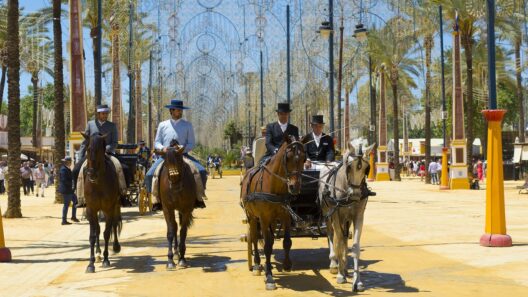
The Feria de Abril – Seville’s April Fair – is the highlight of the city’s social calendar. Hotly anticipated, it is one of the most famous festivals in Spain: six days of conspicuous consumption in casetas (private marquees), sevillanas, processions of gleaming horses and carriages and elegant horsemen and women in traditional Andalucian dress.
The majority of the casetas are members-only or invitation-only, so the experience depends very much on who you know and who happens to be there on the day.
If you are staying in Sotogrande or Cadiz province, the Feria de Abril is accessible as a day trip, with Seville around 1.5–2 hours away by car.
It is worth having the logistics covered in advance: transport, caseta access where possible, guidance on what to wear – stylish dressing is de rigueur – and a rough understanding of how the day unfolds. Although, this being Andalucia, spontaneity will inevitably have a part to play. When it all comes together, the Seville Fair is an experience unlike anything else in southern Spain.
Our guest experience team can arrange private transport to the Feria de Abril for guests staying in the Sotogrande or Cadiz areas and explore caseta invitations. Access to private casetas depends on personal connections and availability, so this needs to be discussed well in advance.
Spanish Cultural Events in Summer
Summer in Spain, with its warm nights, lends itself to evenings spent outdoors at festivals, concerts and ferias.
June through August is one of the busiest periods in the Spanish cultural calendar. As the heat of the day fades, performances move outside and celebrations continue well into the night.
Verbena de Sant Joan / Noche de San Juan (23–24 June)

Date: Overnight 23–24 June
Location: Celebrated across Spain, particularly along the coast
The Verbena de Sant Joan – or Noche de San Juan elsewhere in Spain – marks midsummer with fire.
Across Catalonia, the Balearic Islands, Andalucia and many of Spain’s coastal regions, beaches and public spaces fill after dark with bonfires, fireworks, firecrackers, music and dancing. In Catalonia, coca de Sant Joan is also an essential part of the night.
The celebration has roots in ancient midsummer traditions, with fire associated with purification and renewal. Some people still jump over bonfires, while along the coast there are local rituals involving the sea.
Celebrations begin before nightfall and can continue until sunrise. The character of the night changes enormously depending on where you are, from large public celebrations in cities and resorts to neighbourhood gatherings and local beach traditions.
For guests staying with The Luxury Villa Collection on the Andalucian coast, our guest experience team can advise on the best San Juan celebrations taking place locally during your stay.
Villa matches to celebrate San Juan in Marbella:
Villa Kalypso: A playful four-bedroom villa sleeping 10, just 180 metres from the beach and a 10-minute stroll into Marbella. With a 16-metre pool, hot tub and easy access to the San Juan celebrations.
Villa Acqua: A striking four-bedroom designer villa sleeping 10, just 300 metres from the beach and a short walk into Marbella. With its glass-walled pool and sea-view rooftop terrace, it’s perfectly placed for enjoying San Juan before returning to your own private retreat.
Festival de Cap Roig – Costa Brava, Girona (July–August)
Date: July and August
Location: Jardins de Cap Roig, Calella de Palafrugell, Girona, Costa Brava
The Festival de Cap Roig brings international concerts to an outdoor auditorium in the botanical gardens above the Costa Brava.
The programme runs through July and August and has featured internationally renowned artists including Sting, Diana Krall, Elton John, Michael Bublé and Norah Jones, largely across jazz, pop and singer-songwriter genres, alongside classical and flamenco evenings.
A Cap Roig evening is as much about the setting as the performance. Dinner in Calella de Palafrugell or Begur followed by an open-air concert overlooking the Mediterranean makes for a very good summer evening on the Costa Brava.
Tickets for the most sought-after performances can sell quickly, so it is worth checking the programme and booking well ahead.
Feria de Malaga – Malaga (August)
Date: August
Location: Malaga city – accessible from Marbella, Estepona and surrounding areas
The LVC Destinations: Malaga, Marbella and Estepona
The Feria de Malaga is the longest fair in Andalucia: eight days of joyful music, flamenco and verdiales (traditional folk music and dance from the mountains of Malaga) and horses. With two million attending, this city takes its summer celebrations seriously.
The Feria divides into the daytime programme in the decorated historic centre (the casco antiguo, around Calle Larios) and the evening fairground (the Real de la Feria, in Cortijo de Torres), where the open-access casetas stay lively until dawn.
The Feria is ideally positioned for those staying in a villa in Malaga, or Marbella or Estepona which are just a 30 to 45-minute drive, making an excellent day out – attending the daytime parade along the Paseo del Parque, a tapas dinner in the old town, then experiencing the vibrant evening casetas before returning to the villa.
We can arrange private transport to and from the Feria de Malaga for guests staying in villas across the Marbella and Estepona area, and can advise on the best evenings and specific areas of the fairground worth focusing on.
Spanish Cultural Events in Autumn
As the summer heat begins to dissipate, the cultural events of Spain shift towards harvest celebrations, gastronomy and music.
September through November brings the traditional grape harvest, Barcelona’s largest city festival and, every other year, one of flamenco’s most important events.
Jerez Vendimia – Cadiz Province (September)
Date: Around the first two weeks of September
Location: Jerez de la Frontera (around 35 minutes from Cadiz city)
LVC Region: Sotogrande and Cadiz
The Jerez grape harvest festival – the Vendimia – is a significant part of Andalucia’s agricultural tradition. The sherry bodegas of Jerez de la Frontera, including González Byass, Williams & Humbert and Bodegas Tradición, mark the harvest with events and visits that offer an insight into the beginning of the winemaking process.
The festival traditionally begins with the blessing of the grapes beside the cathedral. In true Jerez fashion, the Vendimia brings together many of the city’s cultural signatures: wine and sherry, flamenco, horses and jerezano gastronomy.
For guests staying in a villa in Sotogrande or Cadiz, a private visit to one of the great bodegas during harvest can feel very different from a standard public tour. The bodegas smell different in September, the freshly harvested grapes are beginning their transformation into wine and the atmosphere across Jerez changes with the arrival of another vintage.
Read our report, An Insider’s Guide to the Art & Culture of Cadiz, for more insight into the traditions and festivals of Cadiz and Jerez.
Our team can arrange private harvest-season visits to Jerez bodegas, including Bodegas Tradición, which also houses an important private collection of Spanish art, alongside specialist-guided sherry tastings. These require advance arrangement during the September harvest period.
La Mercè – Barcelona (September)

Date: Around 24 September
Location: Barcelona
La Mercè is Barcelona’s largest annual festival: four days of free events in the streets, squares and parks of the city, including castellers (human towers), correfoc (fire runs with dragons and devils), gegants (giant papier-mâché figures) and a substantial programme of open-air music.
The castellers build human towers that rise several levels above the square, supported by a dense pinya at the base. The correfoc is a very different proposition: devils and dragons carrying fireworks move through the streets as sparks fly directly above and around the crowd.
Since La Mercè takes place across the city, the experience changes depending on where you watch. Plaça de Sant Jaume, El Born and La Barceloneta all have different programmes, so it is worth deciding in advance which events you most want to see.
If you plan to get close to the correfoc, take local advice seriously: expect noise, smoke and sparks and dress accordingly.
Bienal de Flamenco de Sevilla – Seville (September/October, biennial)
Date: Three weeks through September and October, every two years in even-numbered years (2026, 2028…)
Location: Seville – accessible from Sotogrande, Cadiz province and Marbella
The LVC Destinations: Sotogrande and Cadiz; Malaga, Marbella and Estepona
The Bienal de Flamenco de Sevilla is the world’s most important flamenco festival. Three weeks of performances of dance, guitar and singing in the city’s theatres, including Teatro de la Maestranza and Teatro Lope de Vega, as well as historic venues such as the Alcazar, Monasterio La Cartuja, Royal Artillery Factory, and San Luis de los Franceses church. Ç
Leading performers appear throughout the programme, with editions featuring names including Farruquito, Eva Yerbabuena, Manuela Carrasco, José Mercé, Arcángel, Israel Galván and Sara Baras.
For anyone seriously interested in flamenco as an art form rather than simply seeing a tourist tablao (show), the Bienal is unmissable. This festival is so popular that tickets for the headline performances sell out as soon as they are released, many months in advance.
Headline performances can sell out quickly, often months in advance. The Luxury Villa Collection team can assist with Bienal de Flamenco ticket enquiries and arrange private transport from villas in Marbella and Sotogrande areas to Seville. As the event only takes place every two years, advance planning is essential.
Spanish cultural events in winter
For those visiting in winter, cultural events in Spain continue throughout the cooler months, from Christmas and Three Kings celebrations to the extraordinary Cadiz Carnival.
November through February may be less frenetic than spring and summer, but the cultural calendar in Malaga, Granada and across Andalucia continues year-round.
Malaga Christmas Live Nativity Trail – Malaga (December)

Date: December to 6 January
Location: Malaga city and surrounding towns
The LVC Destinations: Malaga, Marbella and Estepona
Malaga’s Christmas celebrations begin in early December, when the city centre is illuminated for the festive season. The light and music show that illuminates Calle Larios and the Plaza de Constitución attracts the largest crowds and video mapping stories are displayed on the cathedral’s lone tower.
The city’s belenes offer a more traditional side to Christmas in Andalucia. Nativity scenes appear throughout Malaga in churches, public buildings and other spaces. The belén viviente (living nativity scene) tradition in Malaga city and in the Andalucian towns nearby is a highly atmospheric Christmas experience: people of all ages restage the nativity scene in period costume, in these traditional Spanish festivals.
For guests staying in a villa in Estepona or Marbella in December, Malaga makes an easy afternoon and evening outing. Follow some of the belenes, browse the Christmas stalls and stay until after dark to see the lights in the historic centre before dinner.
We can arrange private transport from Marbella and Estepona villas into Malaga and recommend belenes vivientes and other Christmas events taking place in the surrounding Andalucian towns during your stay.
Cabalgata de los Reyes Magos – Mallorca, Barcelona and Malaga (5 January)
Date: 5 January; Three Kings Day on 6 January
Location: Across Spain, including Palma, Barcelona and Malaga
The Cabalgata de los Reyes Magos (the Three Kings Parade) is one of the most eagerly anticipated celebrations of the Spanish Christmas season, especially for children.
On the evening of 5 January, the Three Kings – Melchior, Caspar and Balthasar – arrive in towns and cities across Spain before parading through the streets on decorated floats and throwing sweets to the crowds. Depending on where you are, their entrance may be by camel, horse, boat, train, helicopter or something even more imaginative!
In Mallorca, Palma’s Cavalcada de Reis traditionally begins with the Kings arriving by sea. Barcelona’s parade also starts at the port before making its way through the city, while Malaga’s Cabalgata passes through the historic centre.
Children wake the following morning, Día de Reyes, to find the gifts left by the Three Kings.
In Mallorca, the Palma Cavalcada de Reis is an elaborate affair, with the Reyes arriving by sea on a historic boat. Barcelona’s Cavalcada dels Reis Mags runs 5km from the port through the Eixample to the Montjuic Fountain. The Cabalgata of Malaga leaves from the Ayuntamiento, fill the Paseo del Parque, and end up at the Cathedral. For families staying in any of these places in early January, the Cabalgata makes a magical evening for children.
For families staying in Andalucia in early January, the Cabalgata is one of the loveliest ways to experience a Spanish Christmas tradition with children.
Cadiz Carnival – Cadiz (February)
Date: February – 4–14 February 2027
Location: Cadiz city
LVC Region: Sotogrande and Cadiz
Cadiz Carnival is one of the most emblematic cultural events of Spain: a festival of sharp-witted, topical musical performance centred on singing groups including the satirical chirigotas and lyrical comparsas.
The official competition at the Gran Teatro Falla takes place in the weeks leading up to Carnival. Once the festival itself begins, performances spill into the streets, with official groups and unofficial callejeras singing wherever they can find an audience.
You can experience Cadiz Carnival on several levels. The spontaneous street performances around Plaza San Juan de Dios and Barrio de La Viña are open to everyone, while much of the public dresses up too, adding another layer to the atmosphere.
But the real pleasure of Cadiz Carnival is understanding the songs. They are forthright, topical and sharply critical, taking aim at politics, public figures and whatever else has caught the city’s attention over the previous year. The humour is fast, local and often difficult to follow without context, which makes local knowledge especially valuable.
We can explore Gran Teatro Falla seat access and arrange private transport from Sotogrande-area villas for guests planning a Cadiz visit during Carnival. The team can also help build a wider programme around the festival.
Villa Matches:
Hacienda Vejer: An 11-bedroom country estate sleeping 22, just 10 minutes from Vejer de la Frontera. With two swimming pools, daily breakfast service and beautiful rural surroundings, it’s ideal for larger groups exploring Cadiz and its famous Carnival.
Villa Kaia: A contemporary designer villa by architect Carlos Lamas, overlooking the Atlantic at Atlanterra. Sleeping up to eight, with a 13-metre infinity pool and spectacular ocean views, it offers a peaceful coastal base for discovering Cadiz and its Carnival.
Plan Your Cultural Stay with The Luxury Villa Collection
Many of the cultural events in Spain covered in this guide take place within easy reach of LVC villas in Andalucia: from Cadiz province for Carnival and the Jerez Vendimia to Malaga for Semana Santa, Christmas and the Feria.
Others, including Sant Jordi, La Mercè and Cap Roig, take us further across Spain’s cultural calendar and are worth knowing about if your travels take you beyond Andalucia.
Our Guest Experience Team can do far more than recommend an event. For celebrations taking place during your stay, they can help with the details that make them easier to experience: transport, guides, reservations and, where possible, access that would be difficult to arrange independently.
Just as importantly, they can provide the local context that helps you understand what you are seeing rather than merely watching from the sidelines.
Explore The Luxury Villa Collection and start planning your stay.
Frequently Asked Questions About Cultural Events in Spain
What are the most famous cultural events in Spain?
The most famous cultural events in Spain include Semana Santa, especially in Malaga, Seville and Granada, Cadiz Carnival, the Feria de Abril in Seville and the Bienal de Flamenco de Sevilla. Spain also has a rich calendar of regional celebrations including Sant Jordi in Catalonia, the Jerez Vendimia and La Mercè in Barcelona.
When is the best time to visit Spain for cultural events?
Spring and autumn have an especially strong concentration of cultural events in Spain. Semana Santa and the spring ferias take place between March and May, while September brings the Jerez Vendimia, La Mercè and, in Bienal years, flamenco in Seville. Summer brings outdoor music festivals, San Juan and the Feria de Malaga, while February is the time to visit Cadiz for Carnival.
What is Cadiz Carnival and when does it take place?
Cadiz Carnival is a festival of satirical musical performances centred on chirigotas and comparsas. The official competition takes place at the Gran Teatro Falla in the weeks leading up to Carnival, before performances and celebrations spread throughout the old city. In 2027, Carnival runs from 4–14 February.
What is Semana Santa and how can I attend?
Semana Santa (Holy Week) runs from Palm Sunday to Easter Sunday. Cofradías (brotherhoods) carry floats bearing sculpted religious figures through the streets of cities including Malaga, Granada, Seville and Cadiz.
The experience varies significantly by city and even by where you stand along a procession route. A local guide who understands the processions, the best viewing points and the history behind each brotherhood can add valuable context.
What cultural events are there in Spain in summer?
Summer cultural events in Spain include the Festival de Cap Roig on the Costa Brava, San Juan celebrations across Spain on the night of 23 June and the Feria de Malaga in August. Spain’s warm summer evenings also bring an extensive programme of outdoor concerts and music festivals across the country.

Fiona Flores Watson
You might also like
